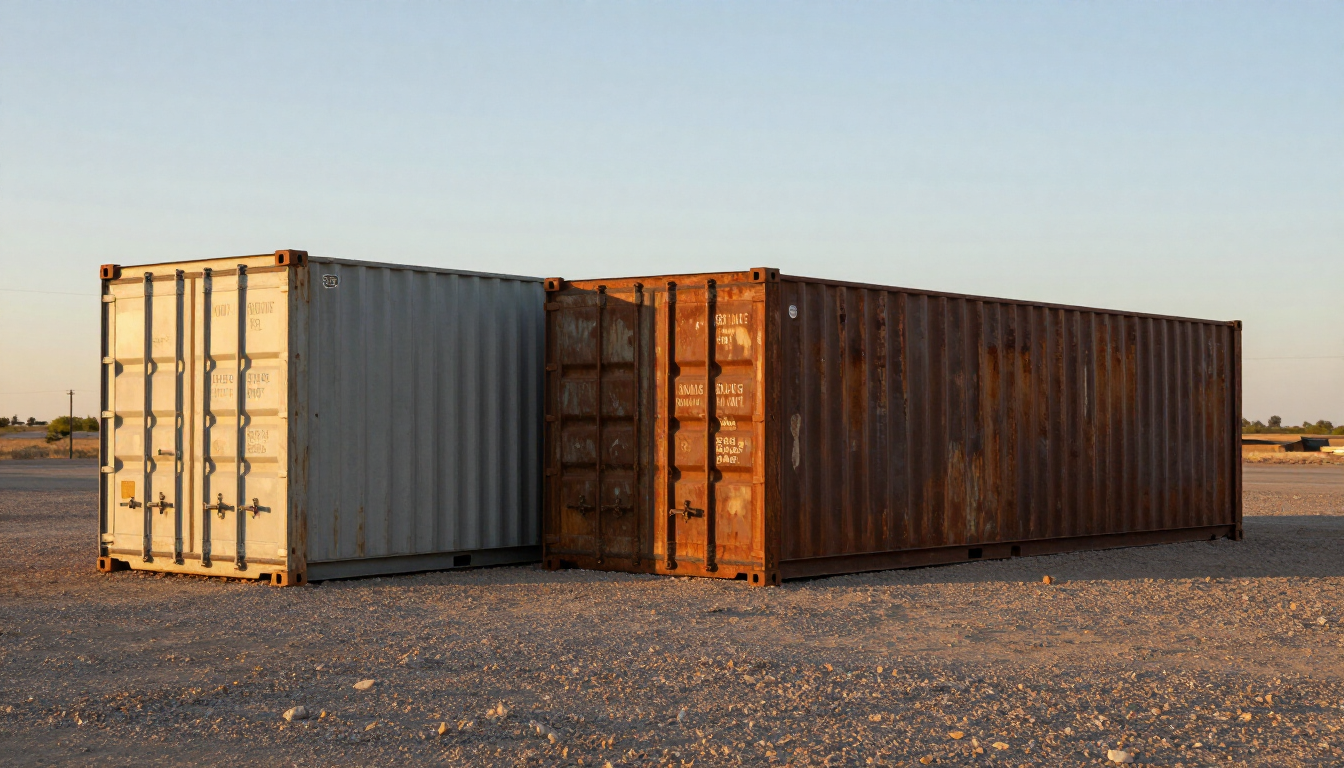
Most buyers assume bigger is better — until the 20 ft unit blocks half the driveway. A side-by-side breakdown of specs, 2026 pricing, placement, and customization so you can choose with confidence.
The size mistake most buyers make
Most buyers assume bigger is better when shopping for a shipping container. Then the 20 ft unit shows up, blocks half the driveway, and won't clear the side gate. It's a common and expensive mistake. For most homeowners, ranchers, and contractors working with real-world space constraints, a compact 10-foot shipping container is the smarter, more practical buy. That's true only if the specs, price, and delivery setup actually fit your situation.
This guide gives you the side-by-side numbers, honest 2026 price ranges by condition, placement requirements, and a clear customization picture so you can make a confident decision before placing an order. Later in this guide, we cover what to look for in a supplier and how to get a real delivered price before placing an order.
How the two sizes actually compare on paper and in your yard
A standard 10 ft container measures 10'0" L x 8'0" W x 8'6" H on the exterior. The usable interior comes in at roughly 9'3" x 7'8" x 7'10", giving you approximately 70 to 80 square feet of floor space depending on interior framing and door configuration — plan around 71 to 75 sq ft as a working estimate. Tare weight runs around 2,870 lb with a payload capacity of approximately 24,910 lb.
A 20 ft container doubles the length to 20'0" while keeping the same 8'0" width and 8'6" height, with interior dimensions of roughly 19'4" x 7'8" and approximately 148 to 150 square feet of usable floor space.
That length difference matters enormously in practice. A 10 ft unit fits in many single parking spaces, clears narrower residential gates, and sits against a fence line without dominating the yard. A 20 ft container, by contrast, often creates access problems on suburban lots and can trigger zoning scrutiny in municipalities that tie permit requirements to total square footage.
Payload capacity and what you realistically store
Many buyers assume a smaller container sacrifices structural strength. It doesn't. Both sizes use Corten weathering steel construction consistent with ISO dry container standards, and the 10 ft unit's payload spec of roughly 24,910 lb far exceeds typical residential or small-contractor storage loads, though you should still calculate your anticipated loaded weight to confirm. The real constraint is interior volume, not structural capacity. Think of it this way: a 10 ft container holds approximately the equivalent of a one-car garage worth of tools, materials, or seasonal equipment.
The question to ask isn't whether the container is strong enough. It's whether roughly 70 to 75 square feet of usable floor space handles your actual use case. A one-car garage's worth of storage covers most residential and small commercial applications, and for those buyers, the compact footprint is the right call.
When the 20 ft makes more sense
The 20 ft earns its place when you're storing palletized inventory, full-length lumber, or setting up a multi-workstation office. It also makes more financial sense on a cost-per-square-foot basis: a used 10 ft unit typically runs $15 to $36 per square foot of usable space, while a comparable 20 ft unit runs closer to $8 to $19 per square foot. If volume is the priority and your site can accommodate the length, the 20 ft is the better value. If space, access, or a tight budget is the constraint, the compact unit wins on almost every metric.
Who gets the most out of a compact 10 ft unit
Homeowners with limited driveway or backyard space
A 10-foot shipping container fits where a 20 ft unit simply won't. Most suburban lots can place one along a fence line or in a side yard without it dominating the property. For homeowners storing lawn equipment, holiday items, or overflow from a garage renovation, the compact footprint is the feature, not a compromise. In many jurisdictions, units under a certain square footage fall below the thresholds that trigger residential building permit requirements, which simplifies the whole process considerably.
Contractors and job site managers
On a tight urban lot or residential build, a 10 ft container parks in spots a 20 ft unit can't reach. It locks up tools and materials without requiring a dedicated staging area, and because it arrives on a tilt-bed truck, placement is precise. Delivery scheduling matters on job sites, and a compact unit lands in more locations than a standard 40 ft flatbed requires. Weather-tight and lockable from day one, a well-placed container moves between jobs as the schedule shifts without the logistics friction of a longer unit.
Ranchers and rural property owners in the Southwest
On a ranch, a 10 ft container earns its place as a chemical storage unit, a small equipment shelter, or a secure spot for fencing supplies at a far corner of the property. Take a rancher in West Texas who needs weatherproof storage at a water station two miles from the barn. A 10 ft unit delivers via tilt-bed truck, sets down on compacted caliche, and handles the job without a concrete slab or crane. Remote placement is exactly where the compact size and tilt-bed delivery combination makes the most practical sense.
New, one-trip, refurbished, or used: what the condition labels mean for your wallet
Pricing for a 10 ft container for sale in the current U.S. market breaks down fairly clearly. One-trip new — the typical 10' container grade, what the industry calls a one-trip 10ft container — ranges from $3,500 to $4,500. A one-trip container made a single cargo run from the factory and is functionally new. Sellers use these terms differently, so knowing what to ask matters more than trusting the category name at face value.
Placement, permits, and site prep before the delivery truck arrives
Ground conditions and access requirements for tilt-bed delivery
Tilt-bed delivery requires a relatively level surface and enough clearance for the truck to back in and tilt the bed down. Compacted gravel, concrete, asphalt, and well-compacted soil all work as a base. Soft, muddy, or waterlogged ground is where problems occur: the container needs to land on four corner supports that sit flat and stable. For truck access, plan for at least 12 ft of clear width, 14 ft of overhead clearance, and roughly 60 to 100 ft of straight run-up for tilt-bed positioning. Low branches, parked vehicles, and tight gate entries are the most common delivery obstacles, so clear those before scheduling.
Permit requirements: when you need one and when you don't
Permit rules vary by municipality, but a few consistent patterns hold across the U.S. Rural and unincorporated properties in Texas and the broader Southwest generally don't require a permit for a container used as personal storage. Incorporated cities and suburban zones are a different story: many require a permit for permanent placement, and some residential districts restrict or outright prohibit shipping containers. HOA communities add another layer of restrictions. Check with your county zoning office before ordering. The 10 ft unit's smaller footprint helps in many jurisdictions because it falls below the square footage thresholds that trigger formal permit requirements, but confirming that with your local office first is the right move.
How Southern Source Container makes buying a compact unit straightforward
Live inventory, inspected units, and no-surprise pricing
Southern Source Container lists inspected, photographed 10 ft containers for sale online so you can see the actual unit before checkout, not a stock photo from a different depot. Each listing includes condition details, and 10ft storage container pricing is calculated by ZIP code using a transparent mileage-based formula. The practical advantage is that you can get a real delivered price estimate without calling for a quote. The total cost, including 10 ft container delivery, is clear from the start, no callbacks required.
Tilt-bed delivery and available customizations
Southern Source Container delivers via tilt-bed truck, placing units on driveways, rural properties, and construction sites without requiring a crane or special rigging. For buyers who want more than a bare steel box, the company offers custom fabrication including roll-up doors, personnel doors, windows, spray foam insulation, electrical, HVAC, and custom paint. Custom builds are designed from buyer-provided drawings or project specs, and the live online inventory makes it easy to find a base unit before discussing modifications.
Customizations that squeeze more value from a smaller footprint
The upgrades that make the biggest difference
A 10 ft container is already secure and weather-tight out of the box. The upgrades that genuinely change how it functions are roll-up doors for wide-load or equipment access, spray foam insulation for temperature-sensitive storage, and a steel lockbox for padlock protection against tampering. Electrical and LED lighting packages turn a bare storage unit into a functional workspace. Basic single upgrades like lockboxes and window cutouts typically run a few hundred dollars, though costs vary by vendor and specification. A full insulation-plus-electrical conversion on a small unit typically lands in the $8,000 to $15,000 range, while mid-level builds that add HVAC, plumbing, and interior finishes run closer to $15,000 to $35,000.
What to request when getting a modification quote
Be specific when requesting custom work. Provide the interior dimensions you need, the intended use (workspace, cold storage, or retail), whether the unit needs to meet local building codes, and any exterior finish requirements. Ask to see photos of comparable completed builds. Confirm whether fabrication happens before or after delivery, since that affects your site timeline. Also clarify lead times: custom builds take longer than standard in-stock units, and planning for that gap upfront prevents scheduling friction on the back end.
The right size comes down to your site, not the price tag
If space, access, or budget is the real constraint, a compact 10-foot container is the more practical, flexible, and often more affordable choice for most residential and small commercial applications. The 20 ft unit earns its place when volume is the priority and the site can handle the length. For everyone else, the compact size fits tighter spaces, clears more gates, and lands on more delivery sites without the logistics friction of a longer unit.
For buyers who've landed on the compact size, the next step is straightforward: check the live 10 ft container for sale inventory at Southern Source Container, get a delivered price by ZIP code, and decide on condition and any customizations before placing the order. Transparent pricing and tilt-bed delivery remove the two biggest friction points in the buying process. If you're ready to move forward or just want to compare units side by side, reach out to the Southern Source Container team directly to discuss your site, your timeline, and the right unit for the job.
Ready to find your container?
Browse live, inspected inventory and get a transparent delivered price by ZIP code — or talk to a specialist about a custom build.